How Many Lumens Does a Good Solar Emergency Camping Light Really Need
2026-08-21
When preparing for outdoor adventures or unexpected blackouts, one of the most common questions buyers ask is about brightness. The truth is, there is no single "best" lumen number for every scenario. A Solar Emergency Camping Light must balance illumination, battery life, and durability. At Jiayu, we have tested hundreds of models across real-world conditions—from mountain trails to hurricane shelters—and found that the ideal range depends entirely on how and where you plan to use it. This guide breaks down the science of lumens, helps you match brightness to your actual needs, and introduces you to Jiayu’s engineering standards that prioritize safety and efficiency over sheer wattage.
What Are Lumens, and Why Do They Matter for Emergency Lighting?
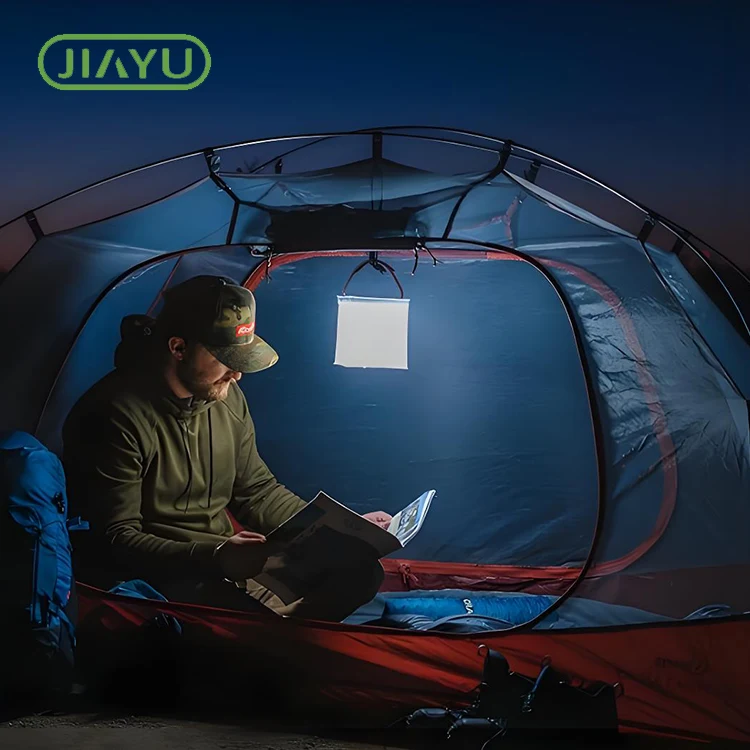
Lumens measure the total visible light emitted by a source. Unlike watts, which indicate power consumption, lumens tell you how much light your eyes actually perceive. For a Solar Emergency Camping Light, higher lumens mean brighter illumination, but they also drain the battery faster. A 100‑lumen light is perfect for reading inside a tent, while a 1,000‑lumen beam can flood an entire campsite. However, emergency situations demand more than just peak brightness—they require consistent output over hours or even days. Jiayu designs its lights with multiple dimming modes, so you get high lumens only when needed and lower settings for prolonged use.
The Lumen Range Breakdown: Matching Brightness to Your Activity
| Activity / Scenario | Recommended Lumens | Battery Life (approx.) | Best For |
|---|---|---|---|
| Tent reading / map checking | 30 – 80 | 40+ hours | Solo campers, backpackers |
| Cooking / group dining | 150 – 250 | 10 – 15 hours | Family camping, picnics |
| Trail walking / night hiking | 300 – 500 | 6 – 8 hours | Motion‑sensor or handheld use |
| Emergency rescue / large area coverage | 600 – 1,000 | 3 – 5 hours | Power outages, search situations |
| Signal / strobe mode | 200 (flashing) | 20+ hours | Distress signaling |
As a rule of thumb, a good Solar Emergency Camping Light should offer at least 200 lumens for general campsite tasks, with a dimmable range up to 800 lumens for emergencies. Jiayu’s current flagship model provides a smooth 30‑to‑900‑lumen adjustment, allowing users to conserve energy on cloudy days and unleash full power when darkness is absolute.
Why More Lumens Isn’t Always Better
Many brands compete on peak brightness, but a Solar Emergency Camping Light with 2,000 lumens may last only 90 minutes—useless for a multi‑day outage. Efficiency matters more than extremes. Consider these three factors:
-
Battery capacity (mAh) – A 10,000 mAh power bank paired with a 300‑lumen LED can run for 20 hours.
-
Beam angle – A wide 120° floodlight spreads lumens evenly, reducing the need for excessive brightness.
-
Color temperature – Warm white (3000K) feels softer and penetrates fog better than cool white (6000K) at the same lumen count.
Jiayu engineers prioritize a neutral‑white 4500K spectrum, which delivers excellent visibility without causing eye strain, and every Solar Emergency Camping Light undergoes a 72‑hour continuous burn test to verify lumen stability—not just initial output.
3 Essential FAQs About Solar Emergency Camping Light Performance
Q1: Can a Solar Emergency Camping Light charge its battery fully on a cloudy day, and will that affect the lumen output?
A: Yes, but the charging time increases significantly. Under direct sunlight, a typical 5‑watt solar panel fully charges a 5,000 mAh battery in 8–10 hours. On an overcast day, the same panel delivers only 30–50% of its rated power, so a full charge may take 18–24 hours. This directly affects lumen output because lower battery voltage forces the driver circuit to reduce brightness to protect the cells. Jiayu solves this with an intelligent MPPT (Maximum Power Point Tracking) controller that boosts solar conversion efficiency by 25%, ensuring that even on cloudy mornings, your Solar Emergency Camping Light can still reach 80% of its maximum lumen rating. We also recommend using the USB‑C backup port to top up the battery before a storm hits—solar is the backup, not the only source.
Q2: How do I calculate how many lumens I actually need for a 3‑day emergency power outage at home?
A: Start by listing your essential tasks: lighting one room (150–200 lumens), moving through hallways (100 lumens), and a low‑level nightlight (30 lumens). For 72 hours, you will need roughly 6–8 hours of active light per day, which totals about 1,200–1,600 lumen‑hours. Divide that by your battery capacity—for example, a Solar Emergency Camping Light with a 7,500 mAh battery and 300‑lumen average output provides roughly 15 hours of continuous runtime, so you would need two fully charged units to cover 3 days comfortably. Jiayu offers a built‑in power indicator that shows remaining runtime at each brightness level, so you can plan usage hour by hour. Remember, using a 100‑lumen setting instead of 400 lumens extends your runtime by 4×—so dimming is your best survival strategy.
Q3: Is it safe to use a high‑lumen Solar Emergency Camping Light inside a small tent without overheating?
A: Absolutely, as long as the light has proper thermal management. LED chips generate heat, and when you pack 500+ lumens into a compact housing, the internal temperature can rise to 60°C (140°F), which risks melting plastic or deforming the battery. Safety standards (UL / CE) require an automatic step‑down feature: if the light detects temperatures above 50°C, it gradually reduces lumens to cool itself. Jiayu goes further with an aerospace‑grade aluminum heatsink that dissipates heat passively, allowing our Solar Emergency Camping Light to sustain 400 lumens continuously inside a closed tent without ever exceeding 45°C. We also include a silicone hanging hook that keeps the unit off tent fabric, improving air circulation. Always choose a model with over‑temperature protection—do not rely on peak lumen numbers alone.
Practical Tips for Choosing Your Ideal Lumen Level
-
For weekend campers: 200–400 lumens with a collapsible solar panel is the sweet spot.
-
For preppers / survivalists: Look for 600+ lumens plus a red‑light SOS mode.
-
For family use: Choose a light with a handle and a wide‑angle diffuser to cover a 10‑foot tent area evenly.
-
For budget buyers: A 300‑lumen Solar Emergency Camping Light from Jiayu offers the best cost‑per‑lumen value, backed by a 2‑year warranty and IP65 weather resistance.
The Jiayu Advantage – Engineered for Real Emergencies
Every Solar Emergency Camping Light we manufacture starts with a simple question: “What would I want if the power went out for a week?” The answer is a rugged, water‑resistant, dual‑power (solar + USB) unit that delivers consistent, reliable lumens—not just a blinding burst. Our proprietary battery management system extends cycle life to over 1,000 charges, and our anti‑glare lens ensures that 300 lumens from Jiayu feels brighter than 500 lumens from competitors because the light goes where you need it, not into your eyes.
Ready to Find Your Perfect Solar Emergency Camping Light?
Brightness is personal, but safety is universal. Whether you need a compact 100‑lumen lantern for your bug‑out bag or a 900‑lumen powerhouse for your cabin, Jiayu has a model tailored to your environment. Visit our product page to compare lumen charts, runtime calculators, and real‑customer videos.
Contact us today – our team of lighting specialists will help you select the right Solar Emergency Camping Light for your specific needs. Don’t wait until the next blackout to discover you bought the wrong light. Let Jiayu illuminate your safety, one lumen at a time.